
What Is the Sciatic Nerve and Why Does It Cause Leg Pain?
Many people are told they have “sciatica” when they begin experiencing pain that travels from the lower back or hip down the leg.
But here is something important that many patients are never told:
Sciatica is not actually a diagnosis.
It simply describes irritation of a nerve — specifically the sciatic nerve.
The sciatic nerve is a real anatomical structure. In fact, it is the largest nerve in the human body. It carries signals between the lower spine, hips, legs, and feet.
When this nerve becomes irritated, compressed, or inflamed, symptoms can appear anywhere along its pathway.
Unfortunately, many people are simply told:
“You have sciatica.”
But that explanation often stops short of answering the most important questions:
• Why is the sciatic nerve irritated?
• Where along the nerve pathway is the irritation occurring?
• What is causing that irritation in the first place?
Many people end up accepting that they simply “have sciatica” rather than discovering the underlying cause of the nerve irritation.
In reality, the symptoms commonly called sciatica are usually the result of mechanical stress on the spine or surrounding tissues that affect the nerve.
Identifying the source of that irritation is often the key to reducing symptoms and improving spinal health.
What Is the Sciatic Nerve?
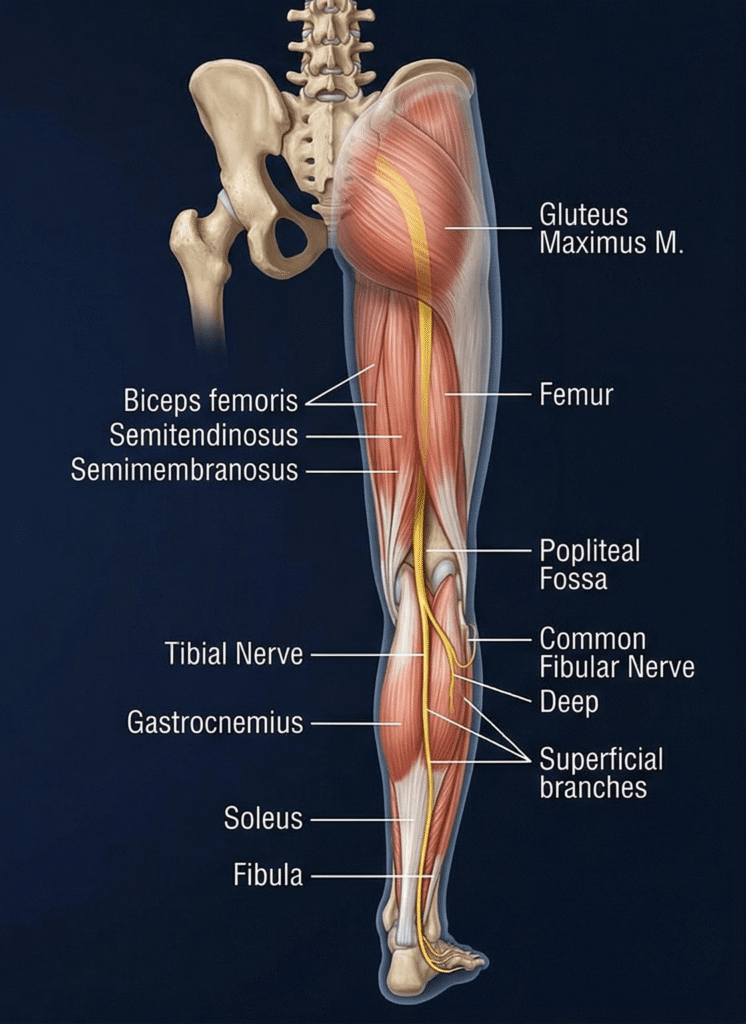
The sciatic nerve is the largest nerve in the human body.
It begins as several nerve roots that exit the lower spine, typically between the levels of L4 and S3.
These nerve roots combine together to form the sciatic nerve, which then travels:
• through the lower back
• into the buttock
• down the back of the thigh
• into the lower leg and foot
Because the nerve runs such a long distance, irritation near the spine can cause symptoms anywhere along the nerve pathway.
This is why people with sciatic nerve irritation often experience symptoms such as:
• pain in the buttock
• pain down the back of the thigh
• numbness or tingling in the leg
• weakness in the leg or foot
In many cases, the leg pain can actually feel worse than any back pain.
Sciatica Is a Symptom, Not the Root Cause
One of the most important concepts to understand is that sciatica is a symptom, not the underlying problem.
Think of it this way.
If someone has a fever, we would not say the fever itself is the disease. The fever is simply a signal that something else is happening in the body.
Sciatica works the same way.
The symptoms may include:
• pain traveling down the leg
• numbness or tingling
• burning sensations
• weakness in the leg
But those symptoms do not explain why the nerve is irritated.
The real question becomes what is affecting the nerve?
Why Many People Are Told They “Just Have Sciatica”
In many healthcare settings, the focus is often on identifying and labeling symptoms.
For example, when someone experiences pain down the leg, they may be told they have sciatica. From there, treatment may focus primarily on reducing the pain.
This approach can be helpful for short-term symptom relief. Medications, injections, and other treatments can play an important role in helping reduce discomfort.
However, labeling the symptom does not always answer the deeper question:
Why is the nerve irritated in the first place?
Many people are left knowing the name of their condition but not understanding what is actually causing the nerve irritation.
When the underlying mechanical stress on the nerve is not addressed, symptoms may return or persist.
A different approach is to ask a deeper question:
What is interfering with the normal function of the spine and nervous system?
Where Sciatic Nerve Irritation Often Starts
In many cases, irritation of the sciatic nerve begins near the lower spine.
Several structures in the spine can influence the nerves as they exit the spinal column.
Spinal Discs
Spinal discs act as cushions between the vertebrae. If a disc bulges or herniates, it may place pressure on a nearby nerve root.
Facet Joint Dysfunction
Facet joints are small joints in the back of the spine that help guide movement. When these joints lose normal motion or begin carrying abnormal loads over time, they can contribute to irritation of nearby nerves.
Changes in Spinal Curves
The spine has natural curves that help distribute forces evenly. When these curves change — such as a loss of the normal lumbar curve — the mechanics of the spine can shift and place additional stress on discs and nerves.
Muscle Compression
In some cases, muscles in the hip region can irritate the sciatic nerve as it passes nearby. One commonly discussed example is piriformis syndrome.
Why Posture Can Affect the Sciatic Nerve

Modern lifestyles often involve long hours sitting at desks, working on computers, or driving.
Over time, this can create postural changes that affect the spine.
When the spine remains in a flexed or slouched position for extended periods, several things may happen:
• increased pressure on spinal discs
• altered joint mechanics
• muscle tension in the hips and back
These changes can contribute to irritation of the nerve roots that form the sciatic nerve.
How Chiropractic Care May Help
Chiropractic care focuses on restoring proper movement and mechanics in the spine.
When joints in the spine lose normal mobility or begin carrying abnormal stress, nearby tissues — including nerves — may become irritated.
Chiropractic adjustments aim to restore mobility to spinal joints and improve spinal function.
In some cases, additional approaches such as:
• spinal decompression
• corrective traction
• posture correction
• rehabilitative exercises
may be used to help reduce stress on irritated nerves and improve spinal mechanics.
Learn More About Sciatica
If you are experiencing pain that travels down the leg, learning more about the causes of sciatic nerve irritation can be an important first step.
You can read more in our article:
Sciatica Chiropractor Near Me in Fort Collins | Fix the Root Cause of Sciatic Nerve Pain
If you are looking for sciatica treatment in Fort Collins, our office focuses on identifying the mechanical causes of nerve irritation and helping patients improve spinal function.
Sciatica Symptoms Checklist
Sciatic nerve irritation can produce a variety of symptoms depending on where the nerve is affected and how much pressure or irritation is present.
Many people experience symptoms that travel along the pathway of the sciatic nerve, which runs from the lower back through the hip and down the leg.
Common symptoms of sciatica may include:
• pain in the lower back or buttock
• pain that travels down the back of the leg
• tingling or “pins and needles” sensations
• numbness in the leg or foot
• weakness in the leg
• pain that worsens when sitting
• discomfort when bending, lifting, or twisting
Some people may feel only mild irritation, while others may experience sharp or burning pain that makes daily activities difficult.
Because the symptoms of sciatic nerve irritation can vary, it is important to determine where along the nerve pathway the irritation is occurring and what is causing it.
Understanding the underlying cause often helps guide the most appropriate approach to care.
When Sciatica May Require Immediate Medical Attention
Most cases of sciatic nerve irritation improve with proper care and time. However, there are certain symptoms that should be evaluated by a medical professional as soon as possible.
Seek immediate medical attention if you experience:
• sudden severe weakness in the leg
• loss of bowel or bladder control
• numbness in the groin or saddle area
• severe pain following a fall or accident
These symptoms may indicate a more serious condition affecting the nerves and require prompt evaluation.
For most people experiencing sciatica symptoms, the condition develops gradually due to mechanical stress in the spine, posture changes, or repetitive strain.
A thorough evaluation can help determine whether the symptoms are related to spinal mechanics, nerve irritation, or another underlying issue.
Common Questions About Sciatica
Can a chiropractor help sciatica?
Chiropractic care may help reduce irritation affecting the sciatic nerve by improving spinal motion and reducing mechanical stress on the spine. Restoring proper joint movement and spinal alignment may reduce pressure on nearby nerves.
How long does sciatica usually last?
The duration of sciatica varies depending on the cause of the nerve irritation. Some cases improve within a few weeks, while others may take longer if the underlying mechanical stress affecting the nerve is not addressed.
Is sciatica always caused by a herniated disc?
No. While disc injuries can contribute to sciatic nerve irritation, other structures can also affect the nerve. Facet joints, posture changes, muscle compression, and altered spinal curves can all contribute to sciatic nerve symptoms.
Why does sciatica hurt more when sitting?
Sitting can increase pressure on the spinal discs and place the spine in a flexed position. This may increase irritation affecting the nerve roots that form the sciatic nerve.
Can exercise or stretching help sciatica?
In some cases, stretching and exercises may help relieve tension around the nerve. However, if the underlying problem involves spinal joint dysfunction or mechanical stress on the spine, restoring proper spinal motion may be an important first step.
Final Thoughts
The sciatic nerve plays an important role in connecting the lower spine to the legs.
When irritation occurs near the spine, symptoms can appear far from the original source.
While the term sciatica is often used to describe leg pain, the real focus should be on understanding why the nerve is irritated and addressing the underlying factors contributing to the problem.
Understanding the cause of sciatic nerve irritation is often the first step toward improving symptoms and supporting long-term spinal health.
If you would like so learn more please contact our office to schedule a consultation or call or text us at 970-377-3557 with any questions.