
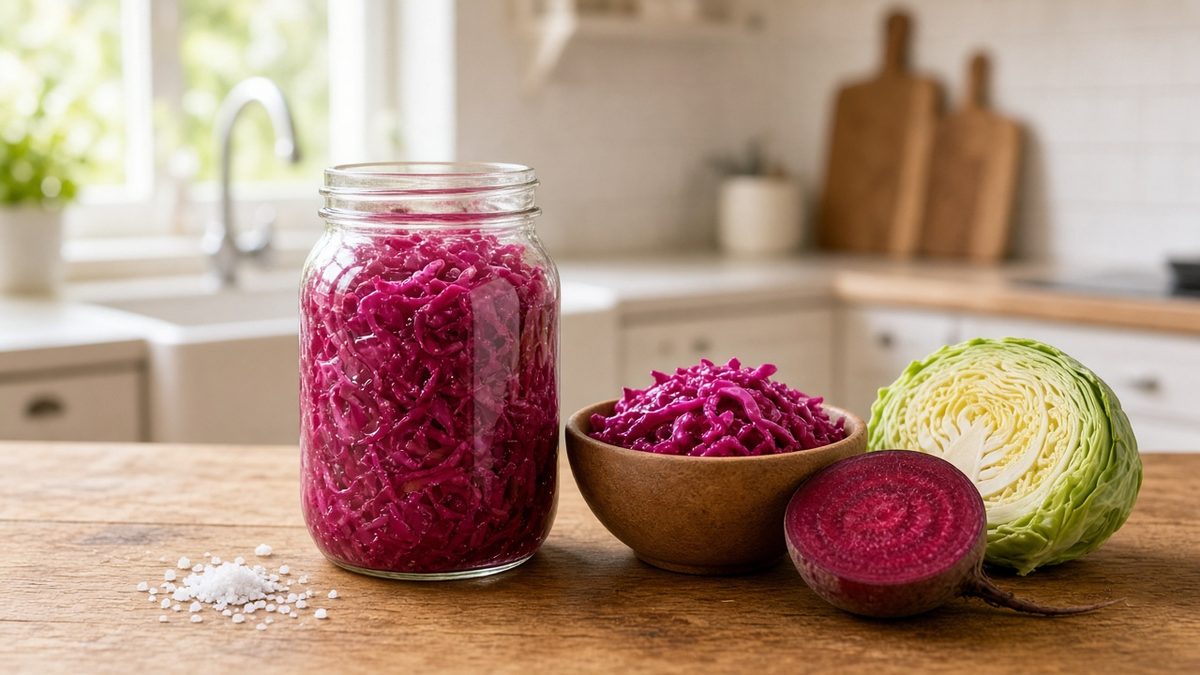
From our Nourish & Flourish recipe cards, this one is a jar of bright magenta kraut you make on your own counter with cabbage, one small red beet, and salt.
Why make it at home? Homemade, unheated kraut is a live-culture food. For live cultures, choose refrigerated, unpasteurized kraut or make your own. In a Stanford study, adults who ate more fermented foods saw their gut microbiome diversity go up, and several inflammation markers in their blood went down. Early, small, but encouraging.
It is pretty, too. Red cabbage brings anthocyanins, the same purple pigments found in berries. Betalains, the pigments in beets, show antioxidant activity in research. Cabbage brings vitamins C and K. Captain Cook packed “sour-krout” to help keep his sailors healthy at sea. And fermenting transforms cabbage’s natural compounds into new ones researchers are studying.
Use 2 to 2.5 percent salt by weight and keep the vegetables under the brine. The salt and brine follow the tested sauerkraut method. Adding beet is a home tradition, so keep this jar in the fridge and don’t can it. Kraut is salty. Think of it as a condiment, a forkful or two. If you have IBS, start small and check with your provider.
Planning for Thanksgiving (Thursday, Nov 26)? Start your jar by about Nov 8 to 12.
Before you start
Most people can enjoy a forkful. If you’re pregnant, immunocompromised, on an MAOI or warfarin, or watching sodium, check with your doctor or pharmacist first.
If you have IBS, start small and check with your provider. New to fermented foods? A little gas or bloating is common at first, so start with a forkful and build up from there.
This is food education, not medical advice or treatment.
Ingredients (makes 1 quart jar)
| Ingredient | By weight | Approximate measure |
|---|---|---|
| Cabbage (green, red, or a mix), cored and thinly shredded, about ¼ inch | 700 g (about 1½ lb) | About 1 small head, or about 10 cups loosely shredded |
| Red beet, scrubbed and coarsely grated | 100 g (80 to 120 g) | 1 small beet, about ¾ cup grated |
| Canning or pickling salt (non-iodized, with no anti-caking agents) | 16 to 20 g (2 to 2.5% of the total vegetable weight) | About 1 Tbsp fine pickling salt (weigh it if you can) |
| Top-up brine, only if needed | 20 g salt per 1,000 g water (a 2% brine) | 1½ Tbsp salt per quart of water, boiled and cooled |
Making a bigger batch? Double everything for a half-gallon jar.
Holiday spice option (per quart jar): add 1 tsp caraway seed and 1 tsp juniper berries, lightly crushed, plus 1 tsp finely grated orange zest (zest only, since the white pith is bitter) and 1 tsp grated fresh ginger. Spices are for flavor only and never replace the salt. The caraway and juniper amounts come from Frontier Co-op’s caraway juniper sauerkraut. The zest and ginger amounts are common home ferment amounts.
The salt rule
Weigh the cabbage and beet together. Then use 2 to 2.5% of that weight in salt.
Here’s the simple math: 800 g of vegetables times 0.02 is 16 g of salt, and times 0.025 is 20 g. Anywhere in that range works.
That matches Colorado State University Extension’s “approximately 3 Tbsp of salt per 5 pounds of shredded cabbage,” and the same 3 Tbsp per 5 lb from the National Center for Home Food Preservation.
Don’t cut the salt. Salt is a safety ingredient here, not just flavor. In NCHFP’s words: “Do not attempt to make sauerkraut or fermented pickles by cutting back on the salt required.” Keep the salt at 2 to 2.5%. If you’re watching sodium, enjoy a smaller serving instead.
Keep the beet to about 10 to 15% of the vegetables. Beets are sweet, and too much sugar can take over the ferment.
Sources: CSU Extension: Understanding and Making Sauerkraut, NCHFP: Sauerkraut, USDA FoodData Central: Cabbage, raw
Steps
- Clean everything. Use a clean quart glass jar (wide-mouth is easiest). Glass, stoneware, or food-grade plastic all work. Skip aluminum, copper, brass, galvanized metal, and iron.
- Shred. Remove the outer leaves, then quarter and core the cabbage. Slice it about ¼ inch thick. Grate the beet rather than cutting it in chunks, because chunks float and are more likely to mold.
- Salt and massage. Weigh the cabbage and beet, add 2 to 2.5% salt, and toss with clean hands. Let it rest 5 to 10 minutes. Then squeeze and massage until plenty of juice pools in the bowl.
- Pack. Press handfuls firmly into the jar until the juice rises over the vegetables. Keep the vegetables at least 1 inch under the brine, and leave at least 1 inch of headspace above the brine.
- Top up if needed. If the juice doesn’t cover the vegetables after packing, or again after a few hours, add the boiled and cooled brine (1½ Tbsp salt per quart of water).
- Weigh it down. Use a glass fermentation weight, a small food-grade zip bag filled with the same salt brine, or a small jar of water. Everything has to stay under the brine.
- Cover. Use an airlock lid, or a regular lid set loosely so gas can escape. If the lid is snug, “burp” it once a day for the first week. Set the jar on a plate to catch any overflow, and don’t pour leaked juice back in.
- Ferment. Keep the jar out of direct sun at 68 to 72°F (CSU) or 70 to 75°F (USDA ideal).
- Taste. Start tasting around days 5 to 7 with a clean fork. When it’s pleasantly sour and still a little crisp, put the lid on tight and move it to the fridge.
A Fort Collins note: at about 5,000 feet, altitude doesn’t change the salt, temperature, or timing for fermenting. Our dry air does evaporate brine faster, though. Keep the jar covered, and top up with the brine if the level drops.
Timeline
| When | What happens |
|---|---|
| Day 0 | Shred, salt, pack, and weigh it down. |
| Days 1 to 3 | Bubbling and a sour smell start, and the brine turns pink-red and cloudy. Burp the jar if the lid is closed. |
| Days 5 to 7 | Start tasting. The beet makes it move a little faster. |
| About 1 to 2 weeks at 68 to 72°F | CSU’s small-batch window. Refrigerate when you like the taste. |
| 3 to 4 weeks at 70 to 75°F (5 to 6 weeks at 60 to 65°F) | USDA’s “fully fermented” point. Below 60°F it may not ferment, and above 75°F it may go soft. |
| In the fridge | Keeps several months tightly covered (NCHFP). Fermentation slows way down. |
For Thanksgiving, start a jar by about Nov 8 to 12.
Keep it in the fridge, and don’t can it
This is a refrigerator ferment. Once it tastes the way you like, lid it tight and refrigerate. Fully fermented kraut “may be kept tightly covered in the refrigerator for several months” (NCHFP).
Don’t can it. Boiling-water canning kills the live cultures you made it for (University of Minnesota Extension). And there is no USDA-tested canning process for a beet and cabbage kraut, so this jar belongs in the fridge.
What to look for in the jar
| What you see or smell | What it means | What to do |
|---|---|---|
| Bubbles, a clean sour smell, cloudy pink-red brine | Normal fermentation. The beet and red cabbage pigments make it pink. | Keep going. |
| A flat white (or pinkish) film on top, called “kahm yeast” | Surface yeast, usually from air exposure. CSU says it can be removed, and the kraut below is still edible. | Skim it off and make sure the vegetables are under the brine. |
| Fuzzy, raised, or colored mold (green, blue, black, gray, or fuzzy white) | Mold. NCHFP’s guidance is that if mold grows, throw it out. | Throw out the jar. |
| Slimy or ropy texture, or a putrid smell | Spoilage, usually from too much warmth or too little salt. The sugar in beets makes slime more likely. | Throw it out. |
| Soft, but it smells and tastes clean and sour | A quality problem (too warm), not a safety one. | OK to eat. Ferment cooler next time. |
| A yeasty or boozy smell | Too much sugar from the beet, or too warm. | If it isn’t slimy or moldy, it’s a quality issue. Use less beet next time. When in doubt, throw it out. |
Sources: CSU Extension, Oregon State University Extension: Sauerkraut Problems and Solutions, NCHFP: Sauerkraut, NCHFP: General Pickling FAQs
Health notes: why fermented foods?
It’s a living food. Homemade kraut is a live-culture food with naturally occurring lactic acid bacteria. They come from the cabbage itself, so you don’t need a starter. (Plengvidhya 2007, Zabat 2018)
What the Stanford study found. In a 17-week study of healthy adults, the group that worked up to about 6 servings a day of fermented foods saw their gut microbiome diversity go up, and several inflammation markers in their blood went down. Early, small, but encouraging. (Wastyk 2021, Cell)
Researchers are exploring more. Researchers are exploring how fermented foods and the gut may connect to the immune system. Lab studies are exploring how compounds made during fermentation interact with gut-lining cells (Wei & Marco 2025). And scientists are actively studying the gut-brain connection, and early diet studies that include fermented foods are exploring stress and mood (Berding 2023).
IBS. A small pilot study found people with IBS reported fewer symptoms eating sauerkraut daily (Nielsen 2018). If you have IBS, start small and check with your provider.
What fermenting does to cabbage. Fermentation changes cabbage, adding tang, live cultures, and new plant compounds, while keeping some of its vitamin C (USDA FoodData Central: Sauerkraut). Fermenting transforms cabbage’s natural compounds into new ones researchers are studying (Palani 2016).
At the holiday table. It’s a bright, tangy, crunchy side that many people enjoy next to a rich holiday plate. Start with a forkful. Kraut is salty, so think of it as a condiment, a forkful or two.
Pink after beets? Pink urine after beets is a common, harmless pigment effect. If you see red without beets, check with your doctor. (StatPearls: Beeturia)
From Dr. Ryan
I love this recipe because it’s a small, hands-on way to care for your body. A head of cabbage, a beet, some salt, and a little patience. That’s it.
Your body is built to heal and function, and your nervous system runs the whole show. Good food is one piece of the picture. A clear signal is another.
Want to keep learning? Read more in The Clear Signal, our monthly newsletter. Or come see us and book a complimentary spinal screening here: https://hnhchiro.com/chiropractic-new-patient-schedule/
Happy fermenting, and happy holidays from all of us at Heart & Hand Chiropractic.
Dr. Ryan Pilsner, DC