
The Clear Signal Live · Replay
Spinal Fitness 101: Simple Daily Moves for Posture, Core, and Your Spine
A Clear Signal Live class with Dr. Ryan Pilsner, DC, at Heart & Hand Chiropractic in Fort Collins. Taught in person on November 17, 2026. Watch the class below, then pick one or two moves to start this week.
Your spine is your lifeline. Most of us were never really taught how to take care of it. We learned about it from pictures of bones stacked like Jenga blocks. But it’s not only a structure. It’s bone, muscle, ligament, tendon, and nerve, all working as one system.
I think about it the way a dentist thinks about your teeth. They don’t just say, “Come back in six months so we can fix what broke.” They hand you a toothbrush and some floss and ask you to do a little work every day. Your spine needs that kind of daily care too. I had my first real spinal emergency at 26, and it still took me a while to get proactive instead of only chasing symptoms. I want you to have the daily piece sooner than I did.
Stretching, exercise, and yoga are all good, and they’re not always enough on their own. This class is about the daily piece: simple moves you can actually do. It’s education, not a diagnosis and not a promise of a result.
Next week’s workshop
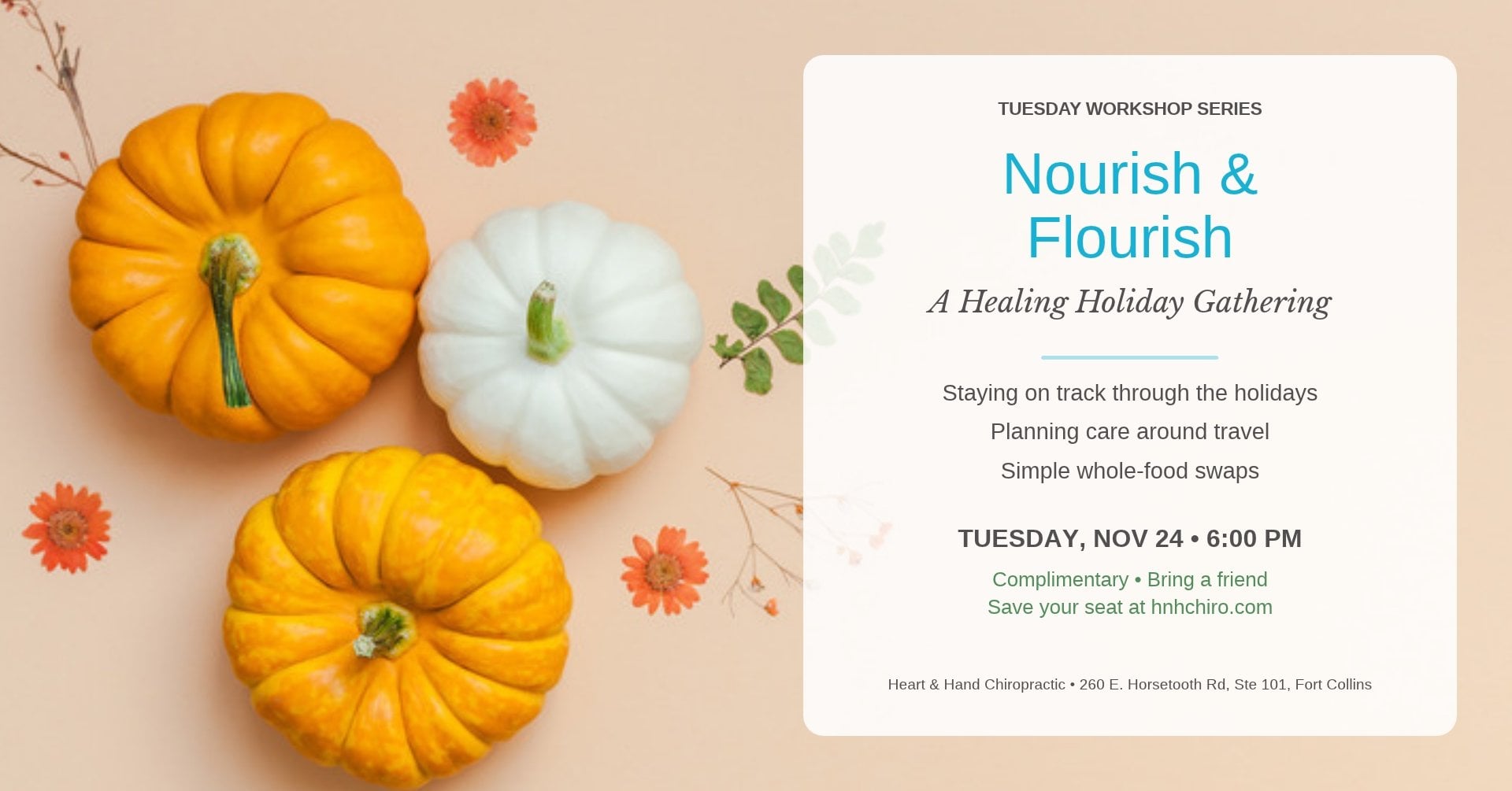
Nourish & Flourish: A Healing Holiday Gathering
Tuesday, November 24, 6:00 to 7:00 PM, at Heart & Hand Chiropractic, 260 E. Horsetooth Rd., Ste 101, Fort Collins. Two days before Thanksgiving, join us for a relaxed evening to help you head into the holidays with a plan. It’s complimentary.
The FLIP neck exercise is demo only in the class. Skip it, and check with your chiropractor first, if you have dizziness, arm numbness, a recent neck injury, Down syndrome, rheumatoid arthritis, known instability, a spinal fusion, or something else complicated in your neck. If you feel numbness, tingling, or weakness, stop.
What you’ll take from the class
- Why I teach “stretch first, then activate” for two common posture patterns, upper and lower crossed syndrome
- Two travel-friendly stretches for the neck and chest, plus Dr. Fedorchuk’s 3-step FLIP neck exercise
- Simple ways to get motion into your spine, from walking to cat-cow
- How to hollow, brace, and plank, and when to try a side plank
- A simple daily rhythm: stretch, move, brace, plank
Upper crossed syndrome and the doorway pec stretch
A lot of us spend the day with work out in front of us: a computer, a phone, a steering wheel, a book. A common pattern is called upper crossed syndrome. The pecs, upper shoulders, and neck can get tight, while the muscles between the shoulder blades and the deep muscles in the front of the neck often do less of the work. It’s a pattern many people live with, not a diagnosis, and these moves aren’t a promise to undo it.
So stretch the short, tight tissue first, then wake up the other side.
- Seated neck stretch. Sit tall and hold the bottom of the chair on the side you’re stretching, so the shoulder stays down. Tip your ear straight toward the opposite shoulder. 30 seconds each side, 3 sets.
- Doorway pec stretch. Both arms at once. Start with your arms straight out to the sides, then raise the elbows about 45 degrees above shoulder height. Ease in until you feel a stretch across the chest and the front of the shoulders, not a pinch in the joint. Hold 30 seconds, 3 times. No doorway? A wall or a high-back chair works.
Both stretches travel well: a rest stop, a hotel doorway, a passenger seat. Not while you’re driving.
FLIP: Dr. Fedorchuk’s 3-step neck exercise
FLIP is not a classic chin tuck, which only slides the head straight back. It has three steps:
- Slide forward. Sit tall and slide your whole head up and forward, at about 45 degrees.
- Tip up. Tip your chin up into a soft C.
- Slide back. Slide your whole head back over your shoulders while keeping your chin up.
Hold for 10 seconds, then relax. At home, once you’ve been checked and cleared, that’s 3 sets of 20. If your chin drops on the way back, start over. I showed this one as a demo only, so please get checked before you try it, and skip it if any of the conditions above apply to you.
Wall angels
After the pecs are stretched, wake up the muscles between the shoulder blades. Think of a snow angel, standing against a wall. Stand with your back to the wall and slowly slide your arms up and down. You usually don’t need weights. Keep it comfortable. About 20 seconds is a fair start. It pairs well with the neck stretch and the doorway stretch after a long spreadsheet session or a long drive.
Lower crossed syndrome: the runner’s lunge and a glute wake-up
The same kind of pattern shows up in the lower body. When we sit a lot, the hip flexors and low back can get tight, and the abs and glutes often do less of the work. Again, it’s a pattern, not a diagnosis, and stretching won’t unwind the whole thing.
- Runner’s lunge. Bring one leg back and keep the spine fairly straight, so you’re not winding through the low back. Once the back leg is set, bend your upper body slightly away from that back leg. Sore knee? Put the back knee on a padded, armless chair and hold the back of the chair for balance. Breathe, then switch sides. 30 seconds each side, 3 sets.
- Glute wake-up. Lie on your side with the hips stacked and the heels stacked. Rotate the top knee out to about 45 degrees, then lower it with control. This is a wake-up, not a “grow big glutes” exercise, so those muscles can share the work when you walk or hike. 30 seconds each side, 3 sets. Before a hike, I’d rather do these at the trailhead.
Movement, your discs, and cat-cow
Every joint in your spine was built to move. An adult disc has almost no real blood supply. Oxygen and other nutrients reach those cells mostly by diffusion from the edges. A disc was built for a body that gets up and moves.
The simplest daily version is walking. In people who walk briskly or run, discs have looked better hydrated on MRI than in people who don’t exercise that way. That’s an association, not a promise about your discs. In one large walking-plus-education trial, people in the walking program went a median of 208 days before a back-pain episode came back, compared with 112 days in the comparison group. That’s one trial, not a guarantee. A short walk after a long sit still counts.
- Cat-cow. On your hands and knees, let the spine round, then ease the other way into a comfortable extension. Smooth and easy, not forced. We bend forward a lot in a day and don’t bend back much. If anything feels sharp or symptoms spread, stop.
Core: hollow, brace, plank, and the side plank
- Abdominal hollow. Sit tall, draw your belly button in, and hold. It’s a wake-up for the deep abdominal wall. Breathe and stay tall.
- Abdominal brace. Don’t pull in or push out. Just lock down, as if you’re checking whether you still have a six-pack in there. I use it when I lift: shoveling snow, groceries out of the car, an awkward reach. Lock it down, then lift, and keep breathing.
- Basic plank. Forearms down, elbows under the shoulders, feet about hip-width apart, a straight, quiet line from head to heels. Don’t let the hips sag or the low back arch. Start with 20- to 30-second holds, 2 or 3 days a week. When the line stays quiet, work toward about 60 seconds. A clean 30 seconds beats a longer sag. Your knees, or a sturdy bench or counter, are a fair place to start.
- Side plank. Only once the basic line is quiet. Lie on your side with your elbow under your shoulder and knees bent. Lift your hips so your knees, hips, and shoulders line up. Hold a comfortable, quiet line, rest, and switch sides. If that’s solid, straighten the legs.
A longer hold does not mean a healthier back, and there’s no one time every body has to hit. If you’re pregnant, have uncontrolled blood pressure, had recent surgery, are in acute severe pain, or can’t bear weight through your shoulders or wrists, get cleared before you plank.
A simple daily rhythm
Stretch, move, brace, plank. Stretch the tight tissue first: the neck stretch, the doorway stretch, and a hip flexor stretch if you’ve been sitting. Get some movement into the spine with a walk and a little cat-cow. Wake up the hollow and the brace. Then plank, and only if the line is quiet, try the side plank. Write it down or set a reminder. The people who actually do these moves are usually the ones who build a cue into their day.
Move safely
If a move feels sharp, spreads, or brings on pain, numbness, or tingling, stop and ease off. If it doesn’t settle, get checked instead of pushing through. If you have a spine condition, a recent injury, or something complicated going on, check with us before you start. This page is education, not a diagnosis.
This week’s handout
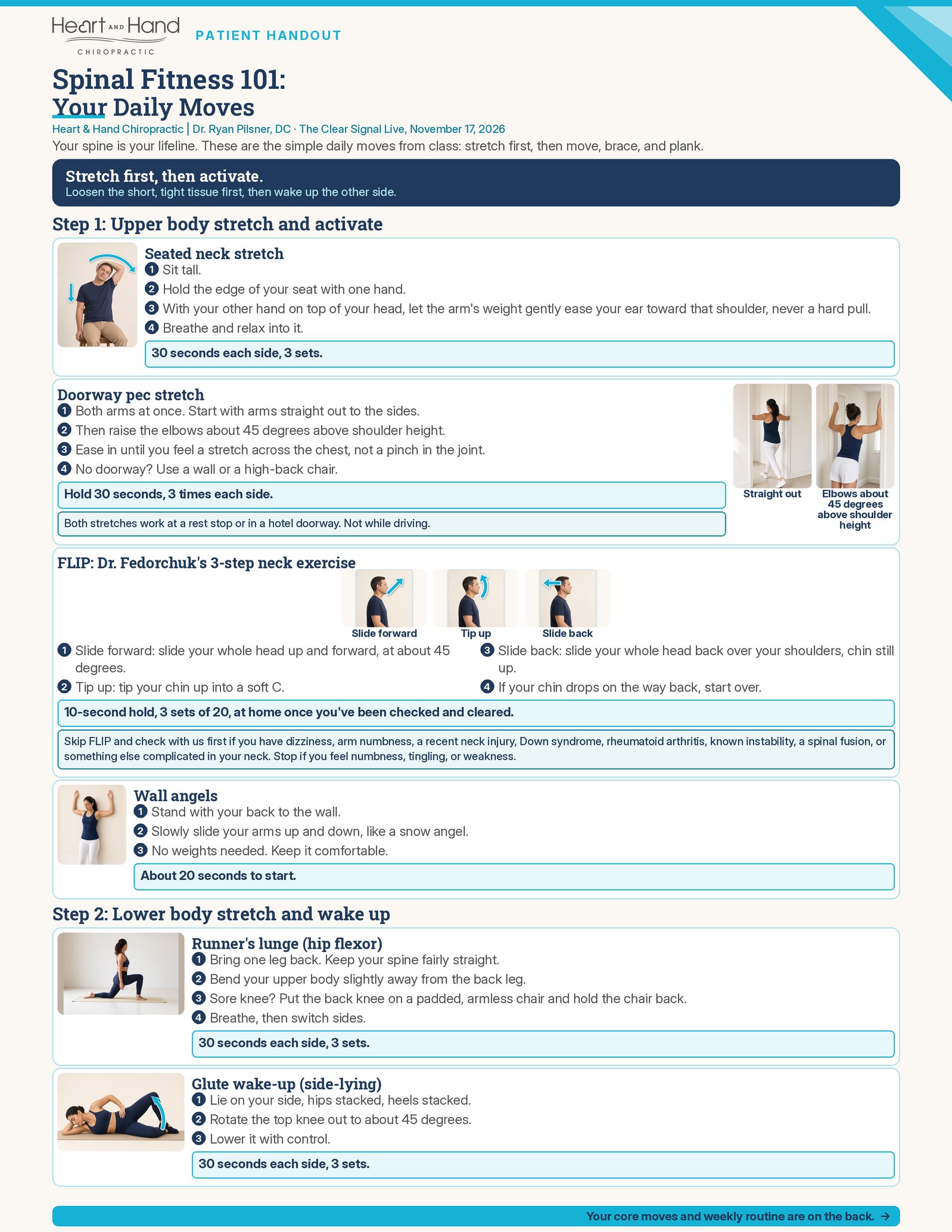
Download the two-sided Spinal Fitness 101 handout, with every move, its dose, and a simple weekly routine.
Want a closer look at your own spine?
These moves are worth doing. They’re not the whole story. If you want to know how your own spine and nervous system are doing, come in for a complimentary spinal screening. We’ll look, listen, and talk with you about what we find. You decide what’s next.
Book a complimentary screening
Or call (970) 377-3557. Heart & Hand Chiropractic, 260 E. Horsetooth Rd, Suite 101, Fort Collins, CO 80525.
Frequently asked questions
What is Spinal Fitness 101? A Clear Signal Live class with Dr. Ryan Pilsner, DC, taught in person at Heart & Hand Chiropractic in Fort Collins on November 17, 2026. It covers stretches and exercises for upper and lower crossed syndrome posture patterns, movement for the spine and discs, and core work from the abdominal hollow to the side plank.
Do I need equipment for these moves? No. A doorway, a wall or a chair, and a little floor space are enough. Wall angels usually don’t need weights.
How long should I hold a plank? In the class, Dr. Pilsner suggests starting with 20- to 30-second holds, 2 or 3 days a week, and working toward about 60 seconds when your line from head to heels stays quiet. A clean 30 seconds beats a longer sag, and a longer hold does not mean a healthier back.
Will these exercises fix upper or lower crossed syndrome? No. These moves don’t fix, unwind, or prevent upper or lower crossed syndrome or back pain. They’re education and a chance to feel how you move. For a closer look at your own spine, book a complimentary spinal screening.
Want to come to the next class in person? See our upcoming workshops.
Sources
- Urban JPG, Smith S, Fairbank JCT. Nutrition of the intervertebral disc. Spine. December 2004.
- Belavý DL, et al. Running exercise strengthens the intervertebral disc. Scientific Reports. April 2017.
- Pocovi NC, et al. Effectiveness and cost-effectiveness of an individualised, progressive walking and education intervention for the prevention of low back pain recurrence (WalkBack). The Lancet. 2024.